The Roll of Network Effects: Ethereum’s Edge Over Solana
The VHS vs. Betamax format war of the late 20th century offers a surprisingly apt historical lens through which to view today’s situation between Ethereum and Solana, the two most prominent smart cont
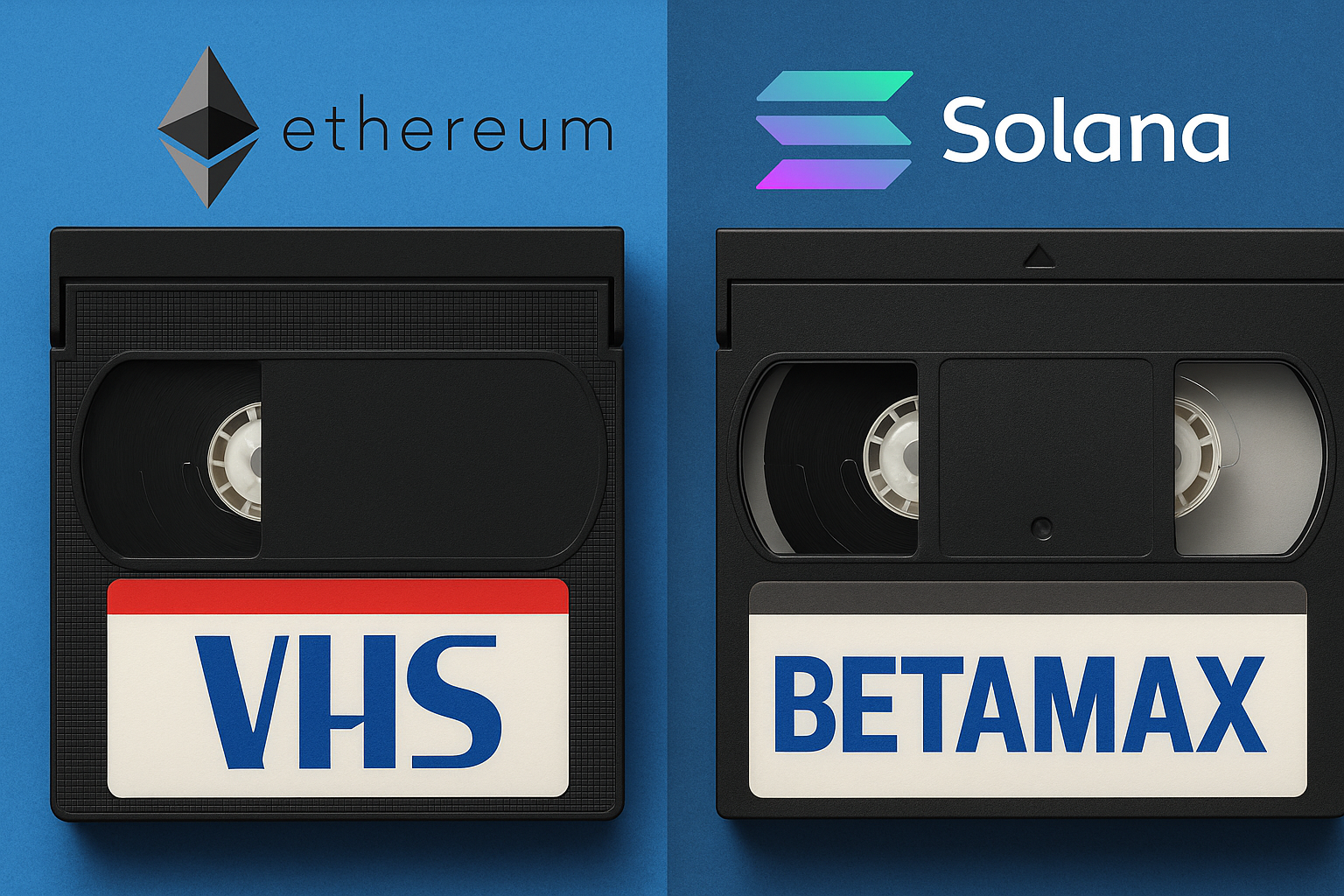
The VHS vs. Betamax format war of the late 20th century offers a surprisingly apt historical lens through which to view today’s situation between Ethereum and Solana, the two most prominent smart contract platforms vying for dominance in the decentralized future. Though Solana may boast technical superiority in isolated benchmarks,- just as Betamax once claimed higher video quality, the long-term winners in technological revolutions tend to be shaped not by raw performance alone, but by broader forces: openness, community adoption, network effects, and the ability to evolve as a platform. Ethereum, like VHS, is winning because of these dynamics, and understanding this parallel helps explain why.
I. The Betamax Fallacy: Superior Tech, Limited Adoption
Sony’s Betamax, introduced in 1975, offered better video resolution and build quality compared to JVC’s VHS. Yet despite its technical merits, Betamax quickly lost ground. Why? Several interlocking reasons:
- Closed ecosystem: Sony tightly controlled Betamax licensing, restricting other manufacturers from producing devices or tapes.
- Shorter recording time: Early Betamax tapes only held one hour of content, VHS quickly offered 2+ hours, better suited for movies.
- Poor third-party support: Movie studios and rental stores gravitated toward VHS because it was cheaper and more widely available.
Solana echoes many of Betamax’s flaws. It boasts high throughput and low transaction costs, undeniably appealing features; but architectural and ecosystem tradeoffs constrain these benefits:
- Vertical integration and centralization: Solana’s reliance on a narrow set of validators, custom hardware, and proprietary systems like Jito’s MEV infrastructure resembles Sony’s top-down control. It limits diversity and resilience.
- Low modularity: Solana doesn’t benefit from the plug-and-play Layer 2 innovation Ethereum enjoys. Like Betamax, its closed-loop architecture discourages flexibility and ecosystem experimentation.
- Narrow developer moat: Solana lacks Ethereum’s robust developer toolkit, such as Solidity’s dominance, multi-client support, EVM compatibility, and the expansive library of composable applications.
Betamax’s failure wasn’t due to its video quality, it was due to its inability to scale culturally, commercially, and communally. Solana risks the same fate.
II. Ethereum as VHS: The Power of Openness and Ecosystem Synergy
VHS won not because it was better technically, but because it was better socially and commercially. JVC licensed VHS openly, allowing a wide range of manufacturers to build players and tapes. The format spread quickly through third-party vendors, movie studios, and consumers, creating a self-reinforcing flywheel of adoption.
Ethereum operates similarly:
- Open architecture: Ethereum’s design is modular, open-source, and programmable. It welcomes Layer 2 innovation, interoperable standards (ERCs), and cross-chain tooling.
- Massive developer network: Ethereum has the largest developer community in Web3. Solidity is the lingua franca of decentralized apps, and the Ethereum Virtual Machine (EVM) is the foundation for two hundred chains.
- Cultural dominance: Ethereum has become the default platform for institutional blockchain efforts (e.g., tokenized assets, stablecoins and ETFs), just as VHS became the default for home video content.
The openness of VHS allowed the market to innovate on top of it. Similarly, Ethereum’s open, permissionless framework has fostered a Cambrian explosion of decentralized finance (DeFi), NFTs, DAOs, and real-world asset tokenization, none of which depend on the Ethereum Foundation alone. This grassroots proliferation gives Ethereum inertia that Solana can’t easily replicate.
III. Network Effects and Composability as Decisive Factors
In both format wars, the network effect mattered more than technical superiority. VHS won because more people used it, which attracted more content, which attracted more users, a recursive loop of growth.
Ethereum exhibits the same flywheel:
- Composability: Apps on Ethereum are interoperable, meaning you can plug DeFi protocols, wallets, NFTs, and DAOs into one another. This is what makes the ecosystem more than the sum of its parts.
- Institutional alignment: Ethereum has become the chain of choice for major institutions, from BlackRock’s tokenization strategy to PayPal’s stablecoin. It’s VHS for the corporate blockchain world.
- Protocol liquidity: The majority of value locked in smart contracts lives on Ethereum or EVM-compatible chains. This liquidity is sticky, once capital commits, it rarely migrates unless dramatically incentivized.
Solana, despite high performance, has struggled to build a comparable feedback loop. The architecture is less composable, the apps less diverse, and the capital less sticky.
IV. The Role of Credibility and Path Dependency
A final parallel is brand trust and perceived neutrality. Just as VHS benefited from being “the people’s format” (open, cheap, flexible), Ethereum benefits from its long-standing commitment to decentralization, neutrality, and security.
Solana, on the other hand, faces questions around its validator set, foundation control, and ecosystem fairness. Its early downtime incidents are akin to Betamax’s failed attempts at broader market alignment, technically avoidable, but reputation-damaging.
In the VHS era, even once Betamax caught up in tape length and price, it was too late, the market had moved. Ethereum’s current lead in cultural trust, tooling maturity, and capital commitment makes it similarly entrenched.
Solana may continue to thrive in niches and offer technical demonstrations of what’s possible with vertically optimized chains. But Ethereum, like VHS, is winning the broader war, not through raw speed, but through openness, developer gravity, institutional embrace, and a rich ecosystem of interoperable applications.
The story of VHS and Betamax reminds us that history favors not the most performant system, but the most adoptable one. Ethereum is winning for the same reasons VHS did: it built the bigger tent, invited the world in, and let the community create its own future.