Understanding SCOPE: Synchronous Composability Protocol for Ethereum
What Is SCOPE? SCOPE, short for the Synchronous Composability Protocol for Ethereum, is a proposed minimalist, push-based protocol that enables smart contracts on Ethereum’s mainnet (L1) and its rollu
What Is SCOPE?
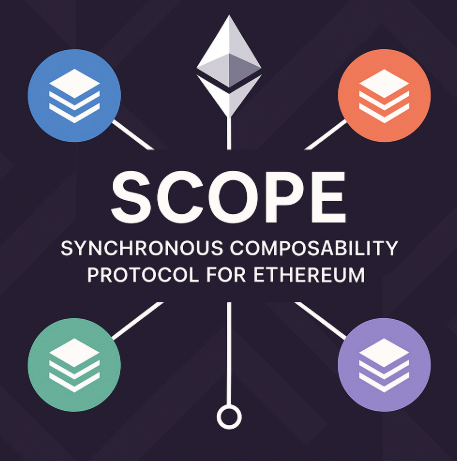
SCOPE, short for the Synchronous Composability Protocol for Ethereum, is a proposed minimalist, push-based protocol that enables smart contracts on Ethereum’s mainnet (L1) and its rollups (L2s, L3s) to call each other synchronously and atomically—just like contracts on the same single chain would. This includes L1 ↔ L2 and L2 ↔ L2 interactions, all wrapped into one atomic scope, so the entire operation either completes or fails together. A minimal proof-of-concept has already been published. (Ethereum Research)
“Explain Like I’m 5“
Picture Ethereum as the mainland and each rollup as an island. Today, islands pass messages in bottles—slow and unreliable. SCOPE gives them phone lines; conversations are instant and two-way, letting smart contracts make decisions across islands immediately.
Why Is It Important?
- Restoring the “Legos” UX: One of Ethereum’s great strengths is composability—DeFi applications could hook into each other instantly in a single transaction. Scaling via rollups broke that fluid UX because rollups are isolated, and cross-rollup actions become disjoint, asynchronous, and slow. SCOPE aims to restore synchronous composability, letting developers and users interact across chains as if they were one. (Ethereum Research)
- Beyond Tokens—Full Logic Coordination: Many existing cross-chain solutions focus narrowly on token transfers (intents), but composability is richer—it’s about letting contracts coordinate logic across chains. SCOPE tailors to this broader goal. (Ethereum Research)
- Based Rollups as Enablers: The concept of based rollups—where Ethereum L1 proposers act as sequencers for L2s—uniquely supports synchronous composability, not just among rollups but also with L1 itself. SCOPE draws from that architectural promise. (Ethereum Research)
Why Is SCOPE Needed?
Ethereum’s rollup-centric scaling offers throughput and lower fees, but at the cost of fragmentation:
- Developer Pain: Contracts that used to call each other seamlessly no longer can. Developers must use bridges, deals fall apart if confirmations fail, and UX suffers.
- User Frustration: Users must “bridge, wait, confirm” for cross-rollup activities—slow, confusing, and risky.
- Liquidity Fragmentation: Money stays siloed in each rollup, hurting capital efficiency and scalability.
SCOPE would simplify all these by reintroducing seamless cross-chain behavior.
How Could SCOPE Be Implemented?
Drawing on the Ethereum Research post and ecosystem innovations, here’s how it might work in a simplified way:
- Push-Based Call Bundles: Inspired by Ultra (a push-based cross-chain model), SCOPE would allow a “bundle” containing calls across multiple chains to be sent in a single push, with proofs of execution readiness.
- Atomic Execution: Bundles are executed atomically across domains: either all sub-calls succeed or all fail. That ensures composability and ACID-like properties across chains.
- Shared Finality + Coordinated Sequencing: Following Spire’s framework, you need:
- Shared finality: Blocks across chains are proposed and finalized together, so one chain can’t be finalized while another is stuck in re-org risk. (Ethereum Research, Ethereum Research, Alex Beckett, HackMD, Spire)
- Coordinated sequencing: Sequencers (or L1 proposers in a based design) synchronize and order cross-chain bundles consistently. (Ethereum Research)
- Mailbox Verification + Proofs: Incorporate mailbox-like message verification from systems like CIRC, to ensure that what is sent is tracked and verifiable—plus fast execution proofs so blocks can be validated quickly enough for real-time atomicity.
- Smart Contracts for Rollups: Provide a base smart contract (like
ScopedCallable) that rollups can implement, making their contract interface compatible with SCOPE’s standards.
Together, this creates a minimal, interoperable protocol—synchronous, auditable, and developer-friendly.
When Might This Be Available?
As of now (August 2025), SCOPE is still a concept supported by a proof-of-concept implementation—no full spec or mainnet version yet. (Ethereum Research) However, there’s substantial activity in its foundational pillars:
- Based sequencing is gaining momentum, with decentralized sequencer architectures being prototyped. (Ethereum Research)
- Spire’s documentation lays out the primitives (shared finality, coordinated sequencing) needed for synchronous composability. (Spire)
- Aggregated settlement and intent-based designs (from aggregated settlement research) pave part of the path toward composable atomicity. (Ethereum Research)
- CIRC and Espresso offer messaging and confirmation infrastructure that could augment SCOPE’s implementation. (Medium)
- Efforts like FABRIC are organizing infrastructure and community collaboration to accelerate based rollup designs. (Ethereum Research)
Realistically, early pilots (like cross-rollup compiler-style setups or DeFi demos) might emerge within a year, with broader adoption in 2–3 years, depending on proof speed, network adoption, and coordination maturity.
What Use Cases Could SCOPE Enable?
Here are practical, human‑friendly examples of what’s possible when seamless, atomic cross-chain calls become real:
- Cross-rollup Flash Loans & DeFi Loops: Borrow on one rollup, arbitrage on another, return funds—all in one atomic call. No need for bridges or manual multi-step management.
- Unified Cross-Chain DeFi: Run a single trade that touches Uniswap on Arbitrum, Aave on Base, and Curve on Optimism—all as if they were one transaction.
- Atomic Multi-Chain Settlements: Back-end services or smart wallets can combine actions across chains (e.g., rebalance portfolio, settle positions, bridge) in one go without partial failures.
- Cross-Chain NFT Shapes: Mint an NFT on one chain, register metadata on L1, and list on a marketplace in another—all atomically, preventing dangling ownership or mismatched state.
- Shared Cross-Chain Oracles and Identity: Oracle updates or identity registry interactions (like ENS) can be read and updated across domains in one transaction.
- DeFi Intent Routing: Wallets ask: “Get best price across these rollups”—routes execution atomically for optimal result.
Essentially, any multi-rollup operation ceases to feel “multi-step” and becomes single-shot, restoring UX, developer simplicity, and capital fluidity.
Summary
- SCOPE is a minimal, push-based protocol enabling synchronous, atomic cross-chain calls between Ethereum L1 and rollups—bringing back composability.
- It’s needed because scaling frameworks (rollups) fragmented the organic UX and liquidity. SCOPE aims to heal that rift.
- It could be implemented via push bundles, atomic execution, shared finality, and coordinated sequencing—building on existing research, tools, and rollup architectures.
- Current status: Concept + PoC; foundational work is underway via Spire, CIRC, aggregated settlement, based sequencing movements, and community efforts like FABRIC.
- Expected timeline: Early pilots in 1–2 years; broader ecosystem adoption over 2–3 years.
- Use cases unleashed: Flash loans, unified DeFi, NFT orchestration, oracle and identity updates, and multi-chain wallet intents—all atomic, instant, and seamless.
References
- jvranek, “SCOPE – Synchronous Composability Protocol for Ethereum”, Ethereum Research (Aug 25 2025) (Medium, Ethereum Research)
- Spire Labs, “Synchronous Composability” documentation (Apr 19 2025) (Spire)
- Research on “Becoming Based: A Path towards Decentralised Sequencing” (Feb 2025) (Ethereum Research)
- Aggregated settlement discussion on ethresear.ch (Dec 2024) (Ethereum Research)
- Espresso/CIRC composability coverage (Espresso, Nov 2024) (Medium)
- FABRIC initiative for rollup infrastructure (Jan 2025) (Ethereum Research)