Underpriced Revolution: Ethereum 2021 vs. 2025
In August 2025, ETH is trading at levels not seen since December 2021. On paper, the price is the same. In reality, the Ethereum network is unrecognizable. Three and a half years ago, Ethereum still r
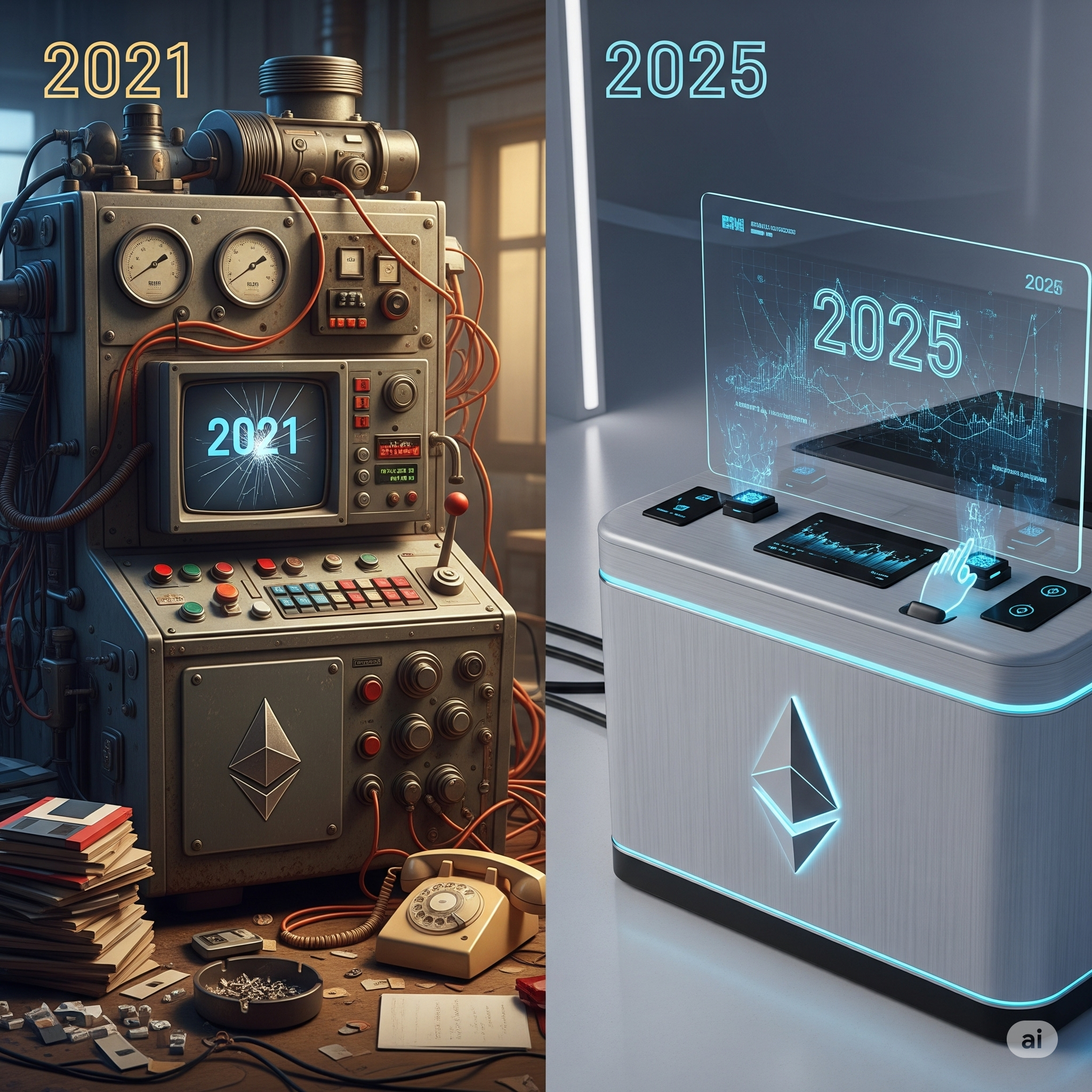
In August 2025, ETH is trading at levels not seen since December 2021. On paper, the price is the same. In reality, the Ethereum network is unrecognizable.
Three and a half years ago, Ethereum still ran on Proof-of-Work, burning energy instead of fees, with gas costs often pricing out users. Staking was a theoretical concept, not a functioning market. Institutional involvement was minimal, and market sentiment was driven largely by speculation.
Since then, Ethereum has gone through four historic protocol upgrades that have permanently altered its economic structure, scalability, and user experience.
The Merge (Sept 15, 2022) replaced Proof-of-Work with Proof-of-Stake, cutting energy use by ~99.95% and slashing ETH issuance to the point of periodic deflation. This was not just environmental PR—it was a fundamental shift toward scarcity economics, once reserved for gold or Bitcoin.
Shapella (Apr 12, 2023) enabled staked ETH withdrawals, transforming staking from an illiquid commitment into a widely accessible yield product. Platforms like Lido, Rocket Pool, and exchanges opened the door, and today 29–30% of ETH is staked—up from nearly zero in late 2021.
Dencun (Mar 13, 2024) introduced EIP-4844 (proto-danksharding), cutting Layer-2 data costs by 50–99%, driving rollup adoption and bringing median L2 fees down to pennies.
Pectra (May 7, 2025) brought a package of user-centric features—smart contract wallets (EIP-7702), social recovery, more flexible staking options, and stronger MEV resistance—positioning Ethereum for mainstream consumer adoption.
While the protocol advanced, the market structure around ETH was rebuilt to accommodate institutional capital. U.S. spot Ether ETFs launched July 23, 2024, recording $1.07B in day-one turnover and $106M in immediate net inflows. In 2025, weekly inflows have reached $2.12B, with ETF holdings now exceeding $25B. This gives pensions, endowments, and corporate treasuries a compliant, soon-to-be-stakeable ETH product—an idea unthinkable in 2021.
Ethereum’s DeFi footprint has also scaled dramatically. Layer-2 TVL in 2025 hit $9B, validating Ethereum’s rollup-centric scaling plan, while core Ethereum TVL now exceeds $100B, commanding a 73% share of the entire DeFi market.
Corporate treasuries are embracing ETH as a reserve asset. Public companies now hold over 3M ETH (~$13B) as of Aug 10, 2025—up from less than 116k ETH at the end of 2024.
Ethereum on-chain metrics confirm the expansion. Weekly active addresses across Ethereum’s multi-chain ecosystem surpassed 20M in June 2025, and the network processes 25.5M daily transactions (including rollups). Post-Dencun, gas costs are down ~95% YoY, making DeFi, NFTs, and gaming vastly more accessible.
Ethereum also dominates the stablecoin sector. As of August 2025, $150B worth of stablecoins live on Ethereum—over half of the global $270B supply—cementing its role as the settlement layer of the digital dollar economy. Real-world asset tokenization is surging, with $6.74B in tokenized U.S. Treasuries live on-chain (led by BlackRock’s $2.9B BUIDL and Franklin Templeton’s $750M BENJI MMF). Total RWA assets excluding stablecoins now exceed $25.5B, the majority hosted on Ethereum.
The rise of corporate Layer-2s is the next frontier: industry-specific rollups for payments, asset classes, and enterprise networks. Ethereum now underpins both permissionless finance and permissioned institutional systems.
Macro conditions have turned favorable as well. The U.S. regulatory climate has shifted from skepticism in 2021 to active engagement in 2025. The SEC, facing legislative pressure, now facilitates compliant crypto markets. Stablecoin legislation is gaining bipartisan traction, and “Project Crypto” is advancing ETF staking and stronger spot market oversight.
In December 2021, there was no Proof-of-Stake, no staking withdrawals, no rollup fee revolution, no ETH ETFs, no $13B in corporate treasuries, no $150B in Ethereum-based stablecoins, no $25B RWA sector, no smart-wallet adoption, and no pro-crypto policy tailwinds.
Yet the market prices ETH the same today as then. That disconnect is more than inefficiency—it’s irrational.
Ethereum in 2025 is faster, cheaper, greener, more secure, more decentralized, more integrated with global finance, and more relevant to institutions than at any point in its history. Every upgrade, ETF inflow, corporate treasury purchase, stablecoin transfer, and RWA launch widens its moat.
If ETH in 2021 was priced on potential, ETH in 2025 should be priced on delivery. And Ethereum has delivered—consistently, visibly, and without pause.
The market may be slow to recognize it, but it never stays blind forever.