Ultimate Guide to ETH as a Productive Asset: 10 Strategies
ETH has evolved into a productive financial instrument. It is a foundational pillar of decentralized finance (DeFi). Unlike static store-of-value assets, ETH can generate real yield across a variety o
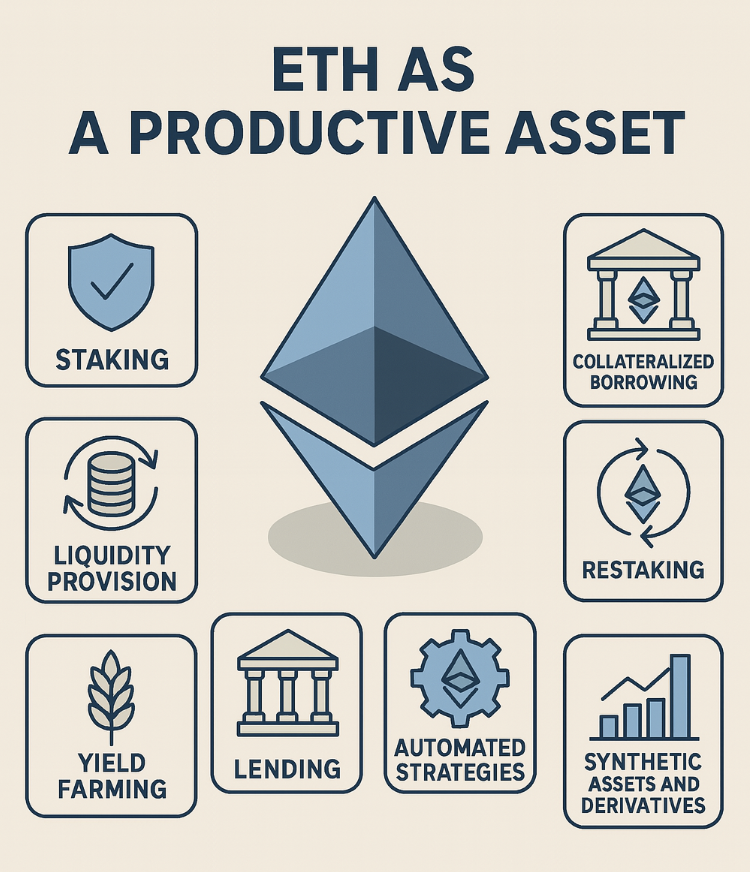
ETH has evolved into a productive financial instrument. It is a foundational pillar of decentralized finance (DeFi). Unlike static store-of-value assets, ETH can generate real yield across a variety of DeFi strategies, enabling capital-efficient, dynamic use within a growing on-chain economy.
Let’s explore how ETH becomes productive, the mechanisms by which it earns yield, examples of platforms enabling these strategies, and the expected returns associated with each.
1. Staking: Ethereum’s Native Yield
Staking ETH is the most direct way to make it productive. Since Ethereum’s transition to proof-of-stake (PoS) in 2022, ETH holders can lock their tokens to secure the network and earn rewards.
Mechanism: Validators are chosen to propose and attest to blocks. In return, they receive ETH rewards.
Yield: Typically 3–5% APY, depending on network participation and total ETH staked.
Platforms:
Solo staking: Requires 32 ETH and technical know-how. You earn protocol-level rewards (typically 3–5% APR) and contribute to decentralization.
Pooled staking: Via Lido (stETH), Rocket Pool (rETH), or centralized providers like Coinbase. You receive a liquid staking token (e.g. stETH, rETH) representing your staked ETH.
Liquid staking (e.g., via Lido) unlocks ETH’s yield potential while maintaining liquidity by issuing a tradable token (e.g., stETH) that continues to accrue staking rewards and can be used elsewhere in DeFi.
⟶ Result: ETH earns a “risk-free” base yield from the protocol and a “modular security yield” from securing middleware.
2. DeFi Liquidity Provision: Earning Trading Fees
ETH and its liquid staking derivatives (LSDs) can be deployed across DeFi protocols to generate additional income. Providing ETH as liquidity to decentralized exchanges (DEXs) allows traders to swap tokens, while liquidity providers (LPs) earn a portion of the trading fees.
Mechanism: Deposit ETH and a paired asset (like USDC or wBTC) into a liquidity pool.
Yield: Can range from 5–20%+ APY depending on trading volume, pool depth, and protocol incentives.
Platforms:
Uniswap (concentrated liquidity model for efficiency)
Curve Finance (especially effective for stable-ETH pairs like stETH/ETH)
Balancer (custom weight pools and incentives)
Impermanent Loss (IL) is a key risk when ETH price moves significantly relative to its pair, your LP value may underperform simply holding ETH.
3. Lending: Earn Passive Interest
ETH can be lent out to other users or institutions who borrow it against collateral. This strategy earns interest with minimal price volatility exposure.
Mechanism: Lend ETH into a protocol’s pool and earn interest from borrowers.
Yield: 1–5% APY depending on platform utilization and demand.
Platforms:
- Aave
- Compound
- MakerDAO (ETH used to mint DAI)
Lending is considered relatively lower-risk in DeFi, especially when overcollateralization is enforced and liquidation mechanisms are well-tested.
4. Yield Farming: Incentivized Liquidity
Yield farming involves staking ETH or ETH-based LP tokens to earn rewards from DeFi protocols, often in the form of native tokens.
Mechanism: Stake ETH, LP tokens, or derivatives into incentivized farms.
Yield: Highly variable—10–100%+ APY during active incentive periods.
Platforms:
Yearn Finance (automated strategies)
Balancer and Aura
Convex Finance (especially for Curve and Frax pools)
High yield = high risk. These protocols often rely on governance tokens that may depreciate rapidly. Rewards may also decay over time as incentives are reduced.
5. Collateralized Borrowing: Leveraging ETH’s Value
ETH can be used as collateral to borrow stablecoins (like DAI, USDC), which can then be reinvested for yield. This indirect yield generation boosts capital efficiency.
Mechanism: Lock ETH as collateral, borrow a stable asset, and reinvest that stablecoin for yield.
Yield: Depends on the reinvestment strategy (e.g., 5–20%+).
Platforms:
MakerDAO (borrow DAI against ETH)
Aave
Compound
Risk of liquidation is high if ETH price drops. Monitoring health ratios is essential to avoid sudden losses.
6. Restaking: Double-Duty for ETH
Restaking allows ETH (or LSDs like stETH) to be used again to secure other networks or services while still earning staking rewards. Through protocols like EigenLayer, staked ETH can be “restaked” to secure additional services (AVSs), potentially increasing yield further.
Mechanism: Stake ETH again to secure Actively Validated Services (AVSs) like bridges, oracles, and middleware.
Yield: 5–15%+ APY from additional restaking rewards.
Platforms:
EigenLayer (pioneer in ETH restaking)
Symbiotic (emerging competitor)
Restaking introduces new risk vectors including slashing, faulty AVS services, and economic misalignment between the base layer and additional services.
7. Automated Strategies: Smart Yield Optimization
Protocols like Yearn Finance or Sommelier automate yield optimization across multiple DeFi platforms, bundling complexity into one simple vault.
Mechanism: Deposit ETH or LSDs into a strategy vault that automatically allocates capital across lending, LP, and farming protocols.
Yield: 5–20%+ depending on strategy and market conditions.
Platforms:
- Yearn Finance
- Harvest Finance
- Sommelier Finance
These vaults are convenient but opaque. Make sure to understand the strategies they deploy and their risk profiles.
8. Synthetic Assets and Derivatives
ETH can be used to mint synthetic assets or enter into derivative positions for speculative or hedging purposes.
Mechanism: Lock ETH to mint a synthetic USD (or other asset), or trade ETH-based options and futures.
Yield: Variable; may come from options premiums or arbitrage.
Platforms:
Synthetix (mint synths like sUSD)
dYdX (futures/perpetuals)
Opyn, Lyra, Panoptic (options)
These tools are more suitable for advanced users and carry higher risk. Used strategically, they can boost ETH’s productivity or hedge exposure.
9. ETH-backed Stablecoins & Yield-Bearing Tokens
Protocols now allow users to mint stablecoins (like crvUSD, Lybra’s eUSD, Prisma’s mkUSD) against ETH or stETH, earning native yield while maintaining stable exposure.
Mechanism: Deposit ETH or LSDs as collateral, mint a stablecoin, and earn yield through stability mechanisms or reward programs.
Yield: 5–15%+ APY depending on the stablecoin and incentive structure.
Platforms:
- Lybra Finance
- Prisma Finance
- Gravita
These stablecoins often earn “real yield” backed by staking rewards from ETH or LSDs.
10. Sophisticated Structured Yield Products
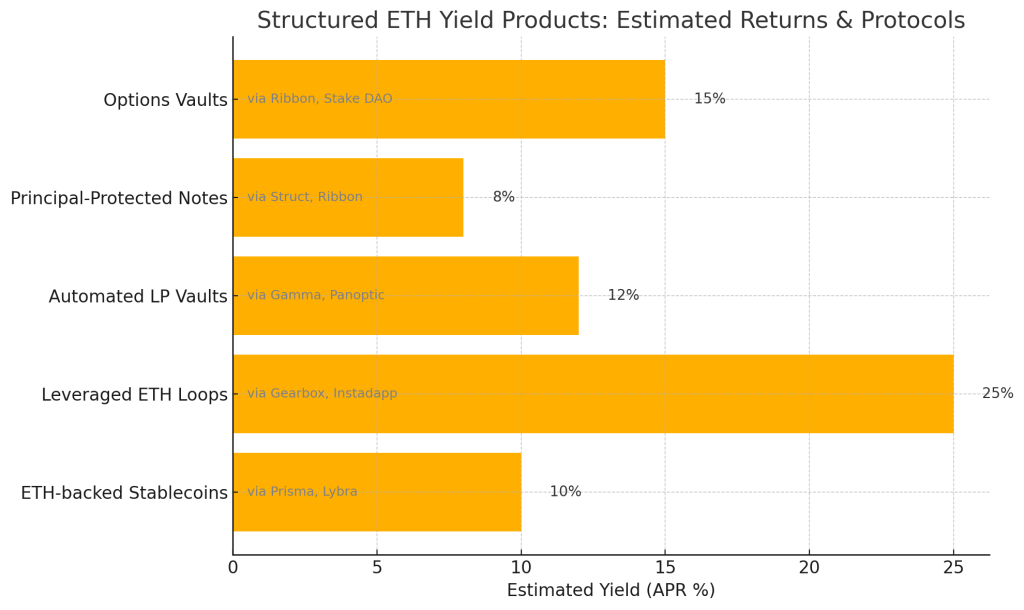
Structured Yield Products are DeFi strategies or instruments that combine multiple financial components to generate yield from ETH or other crypto assets in a more sophisticated and risk-managed way than simple lending or staking.
They resemble structured products in traditional finance—bundled investments using options, derivatives, or algorithmic rules to deliver targeted returns based on market conditions.
Structured yield products typically:
Automate strategies like selling options, providing liquidity, or rebalancing positions.
Target specific outcomes, such as enhanced yield, principal protection, or risk-adjusted exposure.
Wrap complex DeFi behaviors into one token or vault, so users don’t need to manage the underlying mechanics themselves.
Type
Mechanism
Example Protocols
Typical Yield
Options Vaults
Sell covered calls/puts on ETH or LSDs to earn premiums
Ribbon Finance, Stake DAO, Thetanuts
5–20% APR
Principal-Protected Yield Notes
Allocate part of ETH to yield strategy, part to a safe asset
Struct, Ribbon (Vault+Cash)
5–10% APR
Automated LP Vaults
Provide ETH to DEXs with active rebalancing to reduce impermanent loss
Gamma, Panoptic, Arrakis
5–15% APR
Leveraged ETH Loops
Borrow against stETH, buy more ETH, restake — all automated
Gearbox, Instadapp, Sommelier
10–30%+ APR (high risk)
Risks
Smart contract risk: Complex strategies require sophisticated contracts.
Strategy risk: Market downturns, volatility spikes, or mispricing can lead to lower-than-expected returns or even losses.
Lack of transparency: Users must trust the protocol to execute strategies fairly and efficiently.
Limited liquidity: Structured products are often tokenized but may have fewer exit options.
Example Use Case
An ETH holder might:
Stake ETH via Lido → receive stETH.
Deposit stETH into a Ribbon Vault that sells weekly covered calls on ETH.
Earn yield from staking + option premiums automatically.
⟶ Total yield: 4% (staking) + 8–12% (options) = ~12–16% blended return (with risk).
#image_title
Summary Table: ETH Productivity Strategies
Strategy
Yield (APY)
Risk Level
Notable Platforms
Staking
3–5%
Low
Lido, Rocket Pool, Solo Validators
Lending
1–5%
Low–Medium
Aave, Compound, MakerDAO
Liquidity Provision
5–20%+
Medium (IL risk)
Uniswap, Curve, Balancer
Yield Farming
10–100%+
High (reward decay)
Yearn, Balancer, Convex
Collateralized Borrowing
Indirect (5–20%)
Medium–High (liquidation)
MakerDAO, Aave, Compound
Restaking
5–15%+
Medium–High
EigenLayer, Symbiotic
Automated Strategies
5–20%+
Strategy dependent
Yearn, Sommelier, Harvest
Synthetic Assets/Derivatives
Variable
High
Synthetix, dYdX, Opyn, Panoptic
ETH-backed Stablecoins
5–15%+
Medium
Lybra, Prisma, Gravita
ETH as a Next-Gen Productive Asset
ETH is no longer just a speculative commodity; it’s a yield-generating, multi-role productive asset at the core of the decentralized financial system. Its versatility stems from Ethereum’s composable architecture, enabling ETH to participate simultaneously in staking, DeFi, collateral systems, and security services.
As DeFi matures and Ethereum’s network effects deepen, institutional and retail investors alike are beginning to treat ETH as a “crypto bond”—one that offers real yield, programmable utility, and exposure to the emerging tokenized economy.
Ethereum isn’t just where the applications live. ETH is the capital they run on, and it’s working harder than ever.