The Ethereum Performance Paradox: Why One Metric Doesn’t Capture Blockchain Value
There’s an old saying in management: not everything that can be measured counts, and not everything that counts can be measured. Nowhere is this truer than in the debate around how to measure the perf
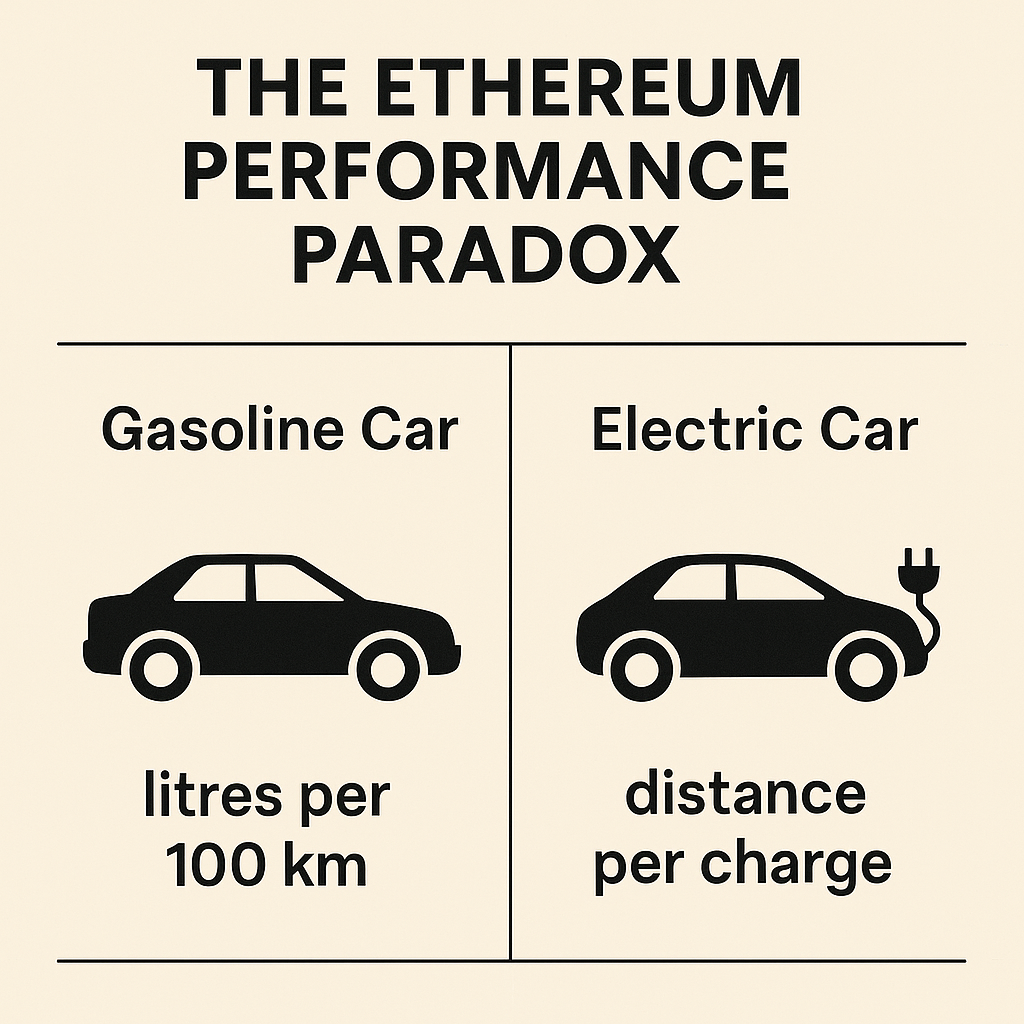
There’s an old saying in management: not everything that can be measured counts, and not everything that counts can be measured. Nowhere is this truer than in the debate around how to measure the performance of blockchains. In Ethereum’s case, the wrong choice of yardstick can obscure more than it reveals, and leave us debating the irrelevant at the expense of the essential.
The Limits of Measurement
Measurement only works when we compare factors that are truly common and comparable. If two organizations or technologies operate on different design principles, weighing them on a single narrowly defined factor creates a distorted picture. This is the paradox of performance: the more complex the system, the less likely that a single indicator captures its essence. What results is often a proxy war: one metric is elevated as a definitive measure, while others are ignored, leading to judgments that can be misleading, if not outright wrong.
Cars, Tanks, and Miles
A simple analogy helps illustrate the problem. Gasoline-powered cars are traditionally rated on fuel consumption: how many litres per 100 kilometers (or miles per gallon) they burn. Electric cars, by contrast, are rated on how far they travel on a full charge. Both metrics attempt to express efficiency, but they are not interchangeable. Imagine if we instead rated gasoline cars solely on the size of their fuel tank. Two cars might share a 60-liter tank, but one might be a fuel-guzzling SUV while the other a compact diesel that goes nearly twice as far on the same volume. The metric, tank capacity, says nothing about actual performance, range, or efficiency. It’s a lazy shortcut that ignores the bigger picture.
Yet this is exactly what happens when analysts latch onto the wrong baseline for blockchain performance.
The Blockchain Trap: Maximum Extractable Revenue
In crypto, one such misleading baseline is Maximum Extractable Revenue (MEV) or, more broadly, transaction revenue. It is tempting to use MEV as a headline number, because it is quantifiable, comparable, and intuitively appealing: more revenue must mean more success. But this is as shallow as rating cars on fuel tank size. MEV is simply one design outcome, reflecting how much value can be pulled out of a system through its transaction ordering rules. High MEV might indicate intense on-chain activity, but it can also signal inefficiencies or user exploitation, akin to calling a gas-guzzler “better” because it burns more fuel.
By that measure, a blockchain could look impressive while being fundamentally extractive, offering little to users beyond feeding intermediaries. It tells us little about whether the chain is actually advancing adoption, enabling new industries, or protecting its users with robust neutrality and censorship resistance.
What Really Counts
Ethereum’s real performance cannot be captured in a single dimension. Its value emerges from a constellation of factors that together define its role as global settlement infrastructure:
Adoption and usage: the breadth of decentralized finance, stablecoins, NFTs, real-world assets, and countless dApps built on Ethereum.
Industry footprint: integration with banks, fintechs, and institutional asset managers who trust Ethereum as a base layer.
Security and uptime: Ethereum has operated with remarkable resilience, maintaining consensus and uptime through immense stress tests.
Neutrality and censorship resistance: the guarantees that anyone, anywhere, can use Ethereum without permission, and no single entity can alter or suppress your information or transactions.
Brand reputation: Ethereum as a recognized, trusted name in both the crypto world and beyond.
These are not always easy to quantify, but they matter more to long-term value than a number that simply reflects how much rent can be extracted from the system.
The Risk of Myopia
The danger in choosing the wrong baseline is twofold. First, it distorts competitive analysis. A chain optimized for extraction could look superior to one optimized for neutrality and resilience, simply because the chosen metric flatters its design. Second, it risks shaping strategy around the wrong incentives. If communities and developers begin to treat MEV or transaction revenue as the scoreboard, they may optimize for precisely the wrong outcomes, user exploitation over user trust, short-term gain over long-term resilience.
This is the Ethereum performance paradox: the temptation to measure what is easily measurable, even when it is not what matters. Ethereum could appear weaker if judged by MEV alone, but this ignores the far larger picture of its role as a global trust and settlement layer.
Beyond the Numbers
This is not to say revenue metrics are not useful. Like tank capacity, they tell us something, they are a data point, a clue, an outcome of certain design choices. But they are not primordial indicators. They are not the essence of performance. The real task is to recognize the multidimensional nature of Ethereum’s value, and to resist collapsing it into a single misleading number.
In complex systems, performance is not a line but a web. Just as cars must be judged on a mix of range, style, efficiency, safety, comfort, and reliability, blockchains must be assessed across adoption, resilience, decentralization, and trust. To isolate one metric and elevate it above all others is to risk misunderstanding the very thing we are trying to measure.
Conclusion
The lesson is simple but profound: be careful in choosing your baselines. Misleading indicators can not only warp comparisons, but also shape narratives and incentives in destructive ways. Ethereum’s performance cannot be reduced to how much can be extracted from its users. Its true measure lies in the breadth of what it enables, the resilience of its infrastructure, and the trust it commands as a neutral, global settlement layer.
Tank size may be easy to measure, but it doesn’t tell you how far the car will take you. MEV may be easy to tally, but it doesn’t tell you how far Ethereum will take the world.