Ethereum’s Fusaka Upgrade: Scaling Smartly Without Sacrificing Decentralization
Ethereum’s roadmap has always been defined by a delicate balancing act: scaling for global use while remaining decentralized enough for anyone to participate. Each major upgrade—whether it was the Mer
Ethereum’s roadmap has always been defined by a delicate balancing act: scaling for global use while remaining decentralized enough for anyone to participate. Each major upgrade—whether it was the Merge, the Dencun rollout, or now Fusaka—pushes the protocol closer to that equilibrium.
The upcoming Fusaka upgrade represents another step in Ethereum’s quiet revolution toward sustainable scalability. It introduces a new way for nodes to share the burden of storing and transmitting data through a system called PeerDAS (Peer-to-Peer Data Availability Sampling). While this may sound highly technical, its real-world implications are profound. Fusaka will make it easier, cheaper, and more inclusive to run a validator—without compromising the integrity or availability of Ethereum’s data layer.
The Core Idea Behind Fusaka
Until now, every Ethereum node had to download and process all “blobs” of data attached to each block. These blobs—introduced in the Dencun upgrade via EIP-4844—store transaction data for rollups and Layer-2s. They’re essential for Ethereum’s scaling future, but they come at a cost: bandwidth and storage demands rise as the number of blobs increases.
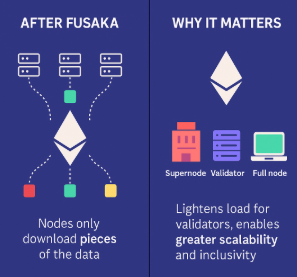
That’s where Fusaka steps in. Instead of every node downloading all data, PeerDAS divides the data into pieces (or columns) and assigns only a subset to each node. Collectively, the network still stores and verifies the full data, but no single node bears the full burden.
In simple terms, Ethereum is learning to divide the workload intelligently. Each node contributes just enough to keep the system robust, yet no one is overwhelmed.
How It Works in Practice
PeerDAS introduces a more differentiated structure for how nodes operate on Ethereum:
- Supernodes: These are large operators—typically exchanges, staking services, or infrastructure providers—running validators with very high stakes (for example, ≥ 4,096 ETH). They handle all data columns and act as the backbone of the network.
- Validating Nodes: The average staker or home validator who runs a single or small set of validators. They download a portion of the data—around one-eighth of what a supernode handles—while still performing critical validation work.
- Full Nodes (Non-Validators): Nodes that stay in sync with the network but don’t participate in validation. They might only handle one-thirty-second of the total data load, keeping bandwidth and storage requirements modest.
This tiered approach means that Ethereum can scale to handle more throughput without forcing every participant to operate at industrial scale.
The Data Behind the Change
According to testing conducted by the ethPandaOps team on developer networks, the results are promising. Even under stress tests with 10 to 14 blobs per block, average home validator setups remain comfortably within safe operating limits:
- Validating nodes recorded download peaks of 15–20 Mb/s and upload peaks of 10–15 Mb/s.
- Full nodes saw much lower usage, around 4–8 Mb/s in both directions.
- Supernodes, while operating at higher bandwidth levels, showed stable performance across peak load cycles.
These figures fit well within Ethereum’s expected capacity envelope (50 Mb/s download and 25 Mb/s upload). Importantly, the results suggest that Ethereum can continue scaling blob throughput without excluding home stakers or smaller operators.
Why This Matters: The “So What”
1. Lower Barriers for Validators
Fusaka dramatically lowers the technical and bandwidth demands for running a validator. Today, home stakers already secure the network with relatively modest setups, but PeerDAS reduces the load even further. This keeps Ethereum accessible to individual operators and reinforces decentralization—the opposite of what happens in blockchains that rely on large, centralized validators or data centers.
2. Sustainable Scalability
Scalability doesn’t just mean “more transactions per second.” It means doing so without breaking the system’s social and technical fabric. Fusaka’s model ensures that data growth remains manageable while maintaining verifiability and fault tolerance. Ethereum can handle more rollup traffic, larger applications, and more data-intensive activity without requiring every node to scale linearly.
3. A Smarter Network Architecture
Ethereum’s evolution toward a heterogeneous node ecosystem—where different nodes play complementary roles—is one of its quiet strengths. Not every participant needs to perform identical work to maintain consensus. By formalizing roles for supernodes, validators, and full nodes, the network becomes more efficient without compromising trust or openness.
4. Enhanced Resilience and Redundancy
PeerDAS doesn’t just save bandwidth—it increases robustness. Even though each node only stores partial data, the system ensures data availability through redundancy and distributed sampling. This design defends against censorship and data loss, which are existential risks for blockchains at scale.
5. Future-Proofing Ethereum’s Infrastructure
Perhaps most importantly, Fusaka gives Ethereum headroom for future growth. As data throughput increases—especially from L2s and appchains—the bandwidth profile for validators will remain within reach of typical consumer-grade internet. That makes the protocol’s scaling trajectory sustainable for years to come.
What It Signals for Ethereum’s Direction
Fusaka is another example of Ethereum’s pragmatic approach to evolution. Rather than chasing raw performance or marketing-driven speed claims, it focuses on credible neutrality, inclusivity, and endurance.
This upgrade reflects a consistent pattern across Ethereum’s history:
- The Merge made it more energy efficient and economically secure.
- Dencun expanded data capacity for rollups.
- Fusaka now makes that capacity sustainable for everyone to participate in.
Together, these milestones demonstrate Ethereum’s strategy of layered innovation—each improvement builds upon the last to balance performance with decentralization.
Fusaka is not the kind of upgrade that makes headlines with flashy numbers or short-term hype. Instead, it strengthens the network’s foundation in quiet, powerful ways. It distributes responsibility more intelligently, reduces barriers for participation, and opens the door for long-term scalability without centralization.
In essence, Fusaka makes Ethereum smarter, not just faster.
It’s how the network scales responsibly — and how it continues to prove that decentralization and performance can coexist.
Sources: