Ethereum Scaling: An Evolving and Strengthening L1–L2 Relationship
Ethereum isn’t moving away from L2s—it’s entering a stronger phase where L1 scaling and L2 innovation advance together. As Ethereum scales directly on L1, L2s are freed to differentiate, specialize, a
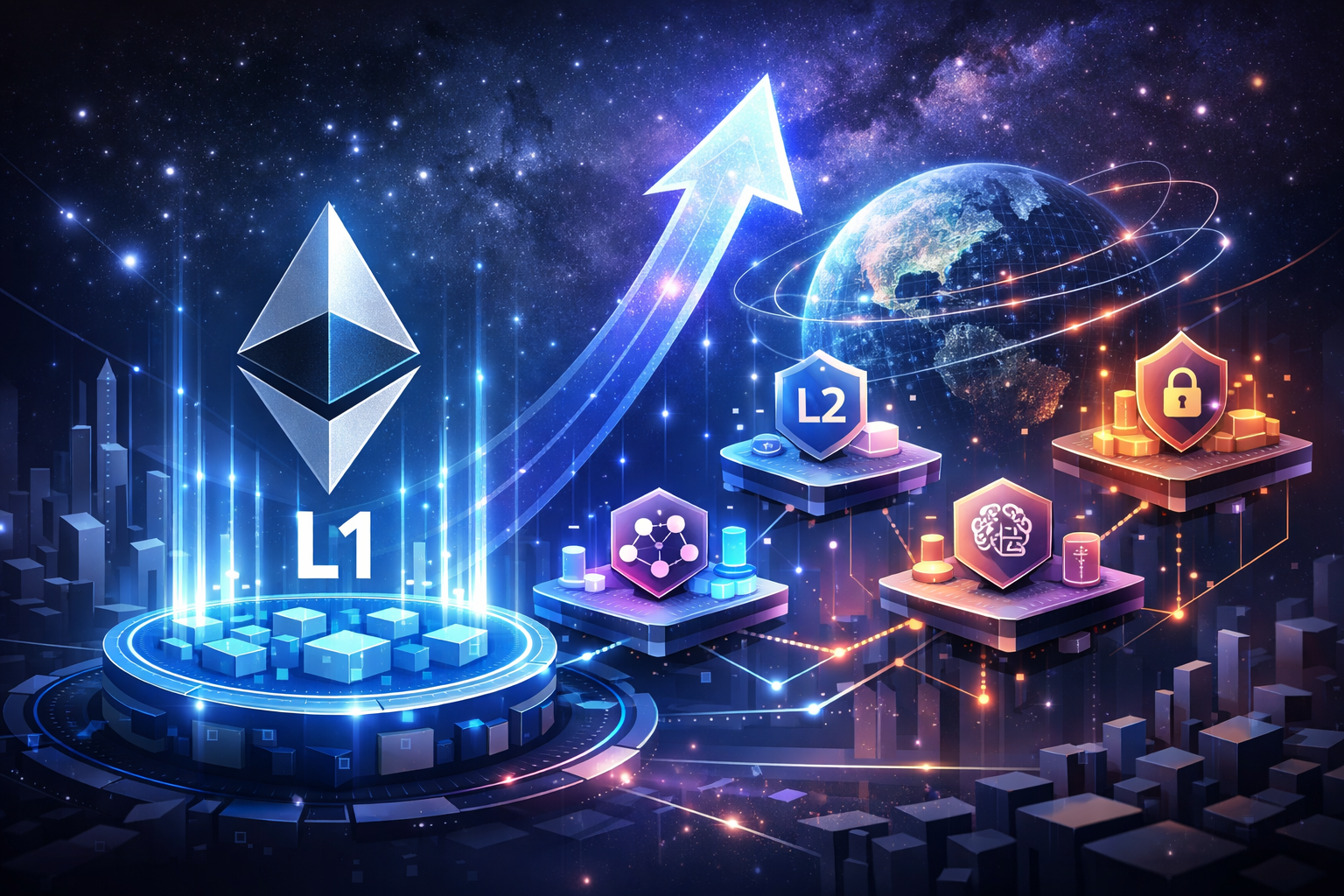
Ethereum isn’t moving away from L2s—it’s entering a stronger phase where L1 scaling and L2 innovation advance together. As Ethereum scales directly on L1, L2s are freed to differentiate, specialize, and innovate beyond pure scaling. The result is a more resilient, flexible, and bullish Ethereum ecosystem with deeper interoperability and broader use cases.
There have recently been thoughtful discussions about the evolving role of L2s within the Ethereum ecosystem, particularly in light of two important developments:
- Progress toward fully trust-minimized (stage 2) rollups—and broader interoperability—has proven more complex and slower than originally anticipated.
- Ethereum L1 itself is scaling meaningfully: fees are currently low, and substantial increases to gas limits are expected through 2026 and beyond.
Rather than signaling a retreat from L2s, these developments reflect Ethereum’s success and maturity. They suggest that the ecosystem is entering a new phase—one in which L1 and L2s scale together, each playing differentiated yet complementary roles.
Reframing the Original Scaling Vision
Ethereum’s original rollup-centric roadmap was grounded in a clear objective: to create large amounts of blockspace backed by Ethereum’s full security guarantees—blockspace where transactions are valid, censorship-resistant, and final so long as Ethereum itself continues to operate.
That vision remains intact. What has changed is how broadly and flexibly it can now be realized.
Ethereum L1 is no longer constrained to minimal throughput. With ongoing protocol upgrades and planned gas-limit increases, L1 can absorb significantly more activity directly, reducing pressure on L2s to function as strict “branded shards” of Ethereum.
At the same time, L2s have diversified. Some are moving toward full trust minimization; others intentionally retain certain controls to meet regulatory, performance, or application-specific requirements. These are rational design choices, often made in service of users—not failures of the model.
Crucially, Ethereum does not require every L2 to look the same in order to thrive.
L2s as a Spectrum of Innovation
A healthier way to view the ecosystem today is to recognize L2s as existing along a spectrum of Ethereum alignment, rather than a single rigid category. This spectrum includes:
- Rollups that inherit Ethereum’s full security guarantees.
- L2s that extend Ethereum with novel execution environments or non-EVM features.
- Application-specific or performance-optimized chains with selective trust assumptions.
- Systems designed for non-financial use cases such as identity, social coordination, privacy, or AI.
This diversity is a strength. It allows developers and users to choose the guarantees and trade-offs that best suit their needs, while Ethereum continues to serve as the neutral settlement and trust anchor beneath it all.
What This Means for L2 Builders
For L2s, this evolution is an opportunity—not a downgrade. The most compelling L2s going forward will differentiate themselves not simply by “scaling Ethereum,” but by adding unique capabilities that Ethereum alone cannot or should not specialize in, such as:
- Privacy-preserving or non-EVM execution environments
- Domain-specific optimization for particular applications
- Ultra-low latency or specialized sequencing
- Architectures tailored for social, identity, or AI use cases
- Integrated oracle, dispute resolution, or off-chain verification systems
At the same time, L2s that work with ETH or Ethereum-issued assets should continue to meet baseline security standards (at least stage 1), and invest in strong interoperability with Ethereum—even when that interoperability looks different across architectures.
Strengthening the L1–L2 Interface
From Ethereum’s perspective, recent progress has reinforced the value of native protocol support for rollups, particularly through a native rollup verification precompile. As Ethereum enshrines ZK-EVM proofs for its own scaling, extending that capability to L2s becomes both natural and powerful.
A native rollup precompile would:
- Make trust-minimized EVM verification universally accessible
- Upgrade automatically with Ethereum
- Benefit from Ethereum’s social and technical commitment to fixing critical issues
Importantly, this design can support L2s that are “EVM plus”—allowing Ethereum to verify the EVM component, while L2s independently prove additional features. The result is strong, trustless interoperability, improved composability, and faster innovation across layers.
A Permissionless Future, Clearly Communicated
As always in a permissionless ecosystem, not every L2 will offer the same guarantees—and some will make trust-dependent design choices. This is inevitable and healthy. Ethereum’s role is not to constrain experimentation, but to provide the strongest possible base layer and the clearest possible guarantees, so users understand exactly what they are opting into.
Bottom Line
Ethereum is not moving away from L2s.
Ethereum is scaling successfully, and that success gives L2s more freedom—not less—to innovate.
L1 scaling strengthens the foundation.
L2 diversity expands the frontier.
Together, they make Ethereum more resilient, more expressive, and more globally relevant than ever.
This is not a retreat from the rollup vision—it is its evolution.
(This is a rewritten interpretation of Vitalik’s post about the changing positioning of the L2s)