Ethereum Leads in the SEC Assessment on Decentralized Governance and Crypto Assets
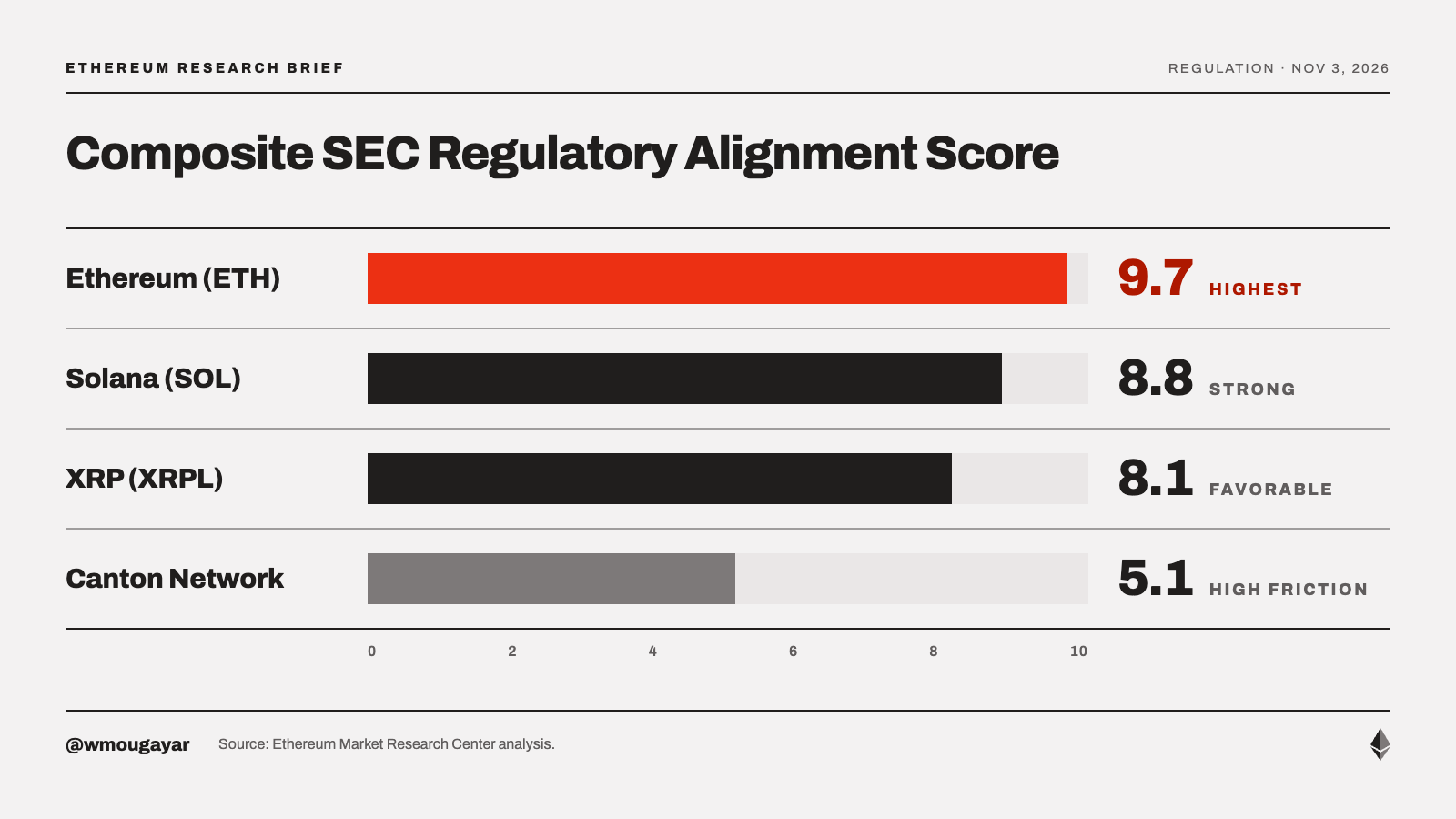
The SEC’s new crypto asset FAQs judge networks by how they actually operate: no central party, broad governance and unencumbered staking. Scored against these tests, Ethereum leads at 9.7/10, followed by Solana (8.8) and XRP (8.1). Canton Network trails at 5.1 because of its permissioned validators and consortium control.
Ethereum Leads in the SEC Assessment on Decentralized Governance and Crypto Assets
Scoring Ethereum, Solana, XRP and Canton Network against the SEC Division of Corporation Finance’s crypto asset FAQs
Nov 3, 2026 · by William Mougayar · Ethereum Market Research Center
KEY FINDINGS
Ethereum 9.7 / 10. Aligns almost natively with the SEC staff’s operational safe harbors and sets the institutional benchmark for decentralized programmatic trust.
Solana 8.8 / 10. Strong alignment, bolstered by client diversification and permissionless validation.
XRP 8.1 / 10. Benefits from secondary-market separation, though concentrated escrow holdings remain a residual consideration.
Canton Network 5.1 / 10. Notable structural friction from institutional validator gating, consortium synchronizer control and permissioned onboarding.
Executive Summary
On September 25, 2026, and as updated through November 2, 2026, the staff of the SEC’s Division of Corporation Finance published interpretive guidance titled Frequently Asked Questions on the Application of the Federal Securities Laws to Certain Types of Crypto Assets and Certain Transactions Involving Crypto Assets.
The guidance establishes an objective administrative rubric that bridges the Howey doctrine with protocol architectures. It defines clear boundaries separating non-security digital commodities from investment contracts, sets precise criteria for what constitutes a disqualifying central party, clarifies the non-security classification of protocol-level staking receipts, and separates post-functionality core software maintenance from essential managerial efforts.
Applying these standards to four production networks reveals a clear taxonomy. Ethereum scores highest, followed by Solana and XRP, while Canton Network’s permissioned design places it in high-friction territory.
Composite Regulatory Alignment Score (out of 10)
| Network | Score | Rating |
|---|---|---|
| Ethereum (ETH) | 9.7 | Highest |
| Solana (SOL) | 8.8 | Strong |
| XRP (XRPL) | 8.1 | Favorable |
| Canton Network | 5.1 | High Friction |
Source: Ethereum Market Research Center analysis.
1. The SEC Staff Guidance and Its Operational Safe Harbors
The Division of Corporation Finance’s updated FAQs clarify five core regulatory boundaries.
Digital Commodities vs. Investment Contracts (FAQ 1.1, 1.4, 1.6)
A digital commodity is not an investment contract if it provides programmatic utility required to use a functional, decentralized crypto system. “Decentralized” requires that no person, entity or coordinated group exercises operational, economic or voting control over the protocol.
The “Central Party” Negative-Control Test (FAQ 1.5)
The staff defines a central party as any actor possessing unilateral authority to:
- Grant or restrict protocol-level access to users, nodes or validators.
- Gate or arbitrarily modify validator consensus participation.
- Modify rules-based code unilaterally, execute rollbacks, or reverse transactions.
Where operations execute strictly via autonomous, rules-based code, or where discretionary adjustments are mediated solely through a broad-based, non-concentrated governance system, no central party exists.
Broad-Based Governance Standards (FAQ 1.4)
A governance framework avoids classification as a coordinated “group” if participants are unaffiliated and hold no explicit or implicit pacts to act in concert outside the open governance system itself.
Insulation of Maintenance and Protocol Burns (FAQ 2.3, 2.4, 2.5)
Once a network is functional, ongoing core engineering, protocol maintenance, client optimizations, ecosystem grants and network-effect promotion do not constitute essential managerial efforts under Howey. Protocol-level fee burns (such as EIP-1559) and buybacks executed on functional, decentralized systems likewise do not create an investment contract.
Staking Receipt Tokens as Non-Security Tools (FAQ 1.2, 1.3)
Staking receipt tokens, such as liquid staking tokens (LSTs), that function as deterministic receipts certifying custody and ownership of deposited digital commodities are treated as digital tools or digital commodities, provided the issuing protocol does not rehypothecate, lend, pledge or encumber the underlying bonded assets.
2. Institutional Scoring and Comparative Rubric
To evaluate the comparative posture of current production blockchains, the Ethereum Market Research Center scored each asset across the SEC staff’s five substantive tests on a 0–10 scale. The composite is the average of applicable dimensions.
Network Evaluation Matrix
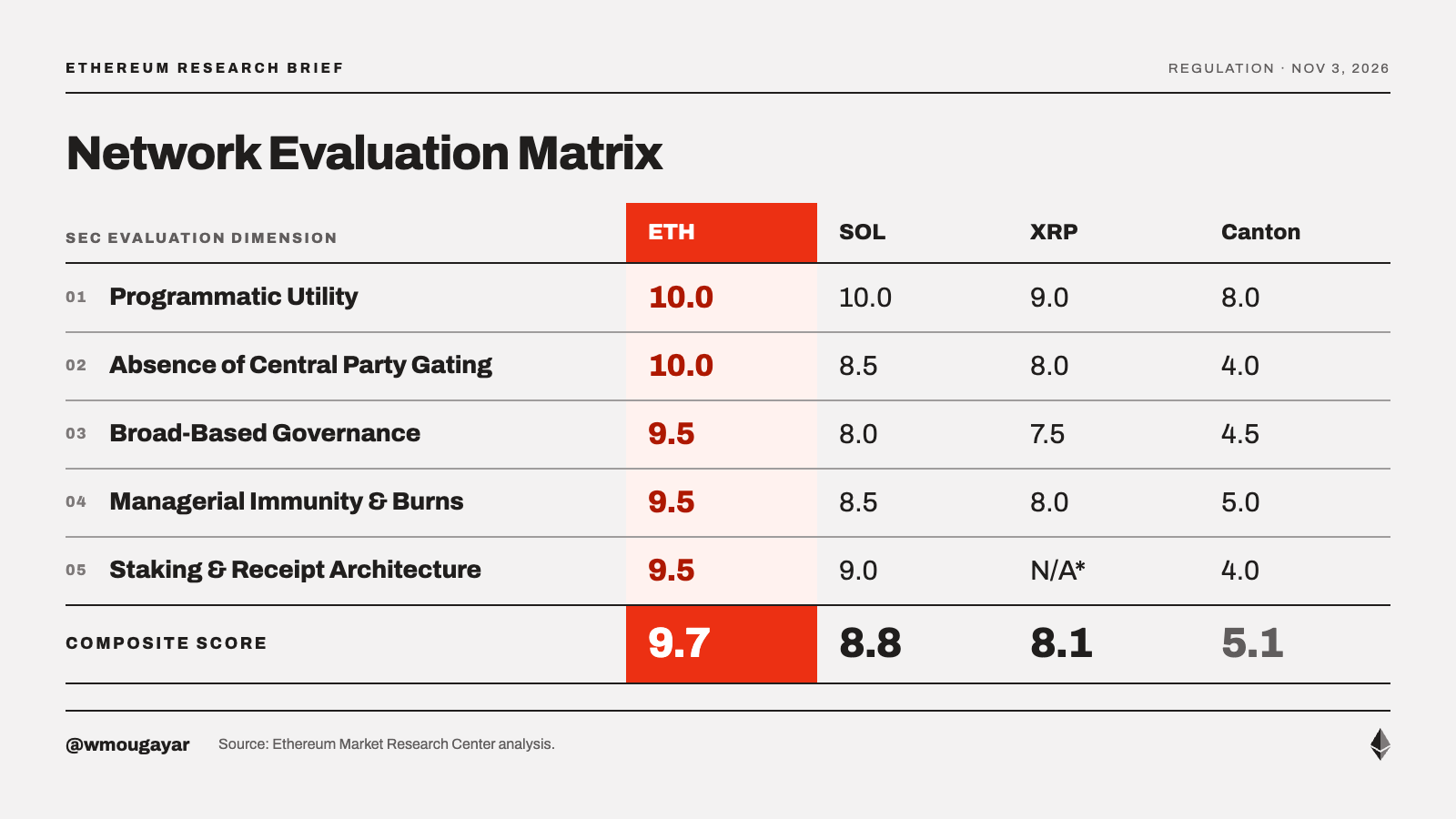
*XRP Ledger operates on a federated consensus protocol without native proof-of-stake staking receipt architecture, and is therefore excluded from Dimension 5; its composite is averaged across four dimensions.
3. Network Implications
Ethereum (ETH) | Composite 9.7 / 10
- Neutral protocol trust. Ethereum serves as the gold standard under this guidance. With no single foundation, client team or entity capable of altering code or halting consensus, it clearly passes the FAQ 1.5 negative-control test.
- Core maintenance safe harbor. The Ethereum Foundation, client development teams (Geth, Nethermind, Besu, Prysm, Lighthouse) and ecosystem grant pools are covered by FAQ 2.3. Ongoing roadmap deliveries, such as statelessness and data availability scaling, are categorized as system maintenance and network-effect support rather than entrepreneurial promises of return.
- EIP-1559 base-fee burns. FAQ 2.5 confirms that programmatic burns executed by a functional system with no central party do not constitute an issuer-driven investment contract.
- Validation of liquid staking. FAQ 1.2 and 1.3 clarify the status of liquid staking tokens. Because smart-contract receipts such as stETH and rETH evidence ownership of locked validator balances without granting an intermediary managerial discretion, lending or rehypothecation powers, they meet the SEC staff’s definition of non-security receipts and digital commodities.
Solana (SOL) | Composite 8.8 / 10
- Client plurality as a regulatory bulwark. Solana historically faced scrutiny over operational restarts and the dominance of the Labs/Agave client. The multi-client transition, highlighted by Firedancer’s mainnet deployment, directly addresses FAQ 1.5 by demonstrating that no coordinated group has operational authority to dictate validator consensus.
- Insulation of foundation roadmaps. Engineering and marketing efforts led by the Solana Foundation are covered by FAQ 2.3. Because Solana has demonstrated production-level functionality since its early launch phases, roadmap communications on throughput or tooling do not convert secondary sales into investment contracts.
- Programmatic burns. As with Ethereum, Solana’s 50% native transaction fee burn is code-enforced, insulating the asset from corporate stock-buyback parallels.
XRP (XRPL) | Composite 8.1 / 10
- Decoupled operation, XRPL vs. Ripple Labs. Under FAQ 2.4, statements by initial sponsors or corporate champions cannot bind a functional asset to an ongoing investment contract if the sponsor lacks unilateral operational control. The decentralized operation of the XRP Ledger, where Ripple operates a small fraction of the default Unique Node List (dUNL), aligns with this principle.
- Residual friction in supply structure. Ripple’s multi-billion token escrows remain a vector for scrutiny under the broader definition of “economic control” in FAQ 1.4. While XRPL’s operational execution is autonomous, institutional markets must continue to distinguish native secondary trading of XRP from direct corporate sales by Ripple Labs.
Canton Network | Composite 5.1 / 10
- Direct exposure to the central party test. Canton’s architecture is tailored for institutional composability and regulated financial workflows, which clashes with FAQ 1.5. Where designated consortium synchronizers or administrative entities retain authority to admit nodes, gate transaction execution, enforce compliance blacklists or reverse invalid settlements, the SEC staff considers that governing group a central party.
- Consortium affiliation issues. Under FAQ 1.4 (Footnote 2), broad-based governance requires participants to be non-affiliated and free of formal or informal agreements to act in concert. Institutional consortia bound by enterprise service agreements or joint venture pacts risk classification as a coordinated group exercising joint control.
- Token classification roadblock. To achieve digital commodity classification under Section III of the SEC’s March 17 Release, Canton subnets and utility layers would need to eliminate centralized synchronizer veto points and move toward autonomous, permissionless settlement verification.
Conclusion
The Division of Corporation Finance FAQs mark an important evolution in digital asset oversight. By grounding regulatory treatment in operational mechanics such as validator autonomy, multi-client governance and non-rehypothecated custody, the guidance provides a clear architectural template for protocol design and compliance. On every one of those mechanics, Ethereum is the reference implementation.
About the Ethereum Market Research Center. The Ethereum Market Research Center (ethmrc.com) publishes research, analysis and news on Ethereum from key ecosystem participants.
Disclaimer. This report reflects the Ethereum Market Research Center’s interpretation of SEC staff guidance. Staff FAQs represent the views of the Division of Corporation Finance and are not rules, regulations or statements of the Commission. Scores are analytical judgments, not legal determinations. Nothing in this report is legal or investment advice.